
Feedback, trust and performance
My admin assistant, Bermee Evangelista, has been working with me for four years. We’ve never met in person and yet have formed a strong working relationship of mutual respect, trust and appreciation. In our four years, we’ve had some ups and downs – as any relationship would. We’ve each had times where we struggled personally, and our work suffered. I know when I’m distracted by personal challenges, I’ve appreciated the patience, grace and support Bermee has shared. I hope I’ve done the same, but I know I’ve had a few missteps along the way. I share all of this because I’ve realized in the past 6 months what an invaluable team member Bermee is. Leading others can be hard. It’s challenging to find the right balance between routine work and opportunities to learn and grow. It takes time and patience to provide feedback and insight to know when something isn’t working, and you need to make a change. Above all, I’ve learned that open, honest, vulnerable communication is the cornerstone for creating a strong working relationship.
For years, I’ve been working with leaders to help them be more effective at providing feedback. Models and acronyms abound – CEDAR, KISS, SBI, SKS, 2 Plus 2 – the list goes on. All of these focus on a process for giving feedback, which is helpful but can feel a bit contrived. Michael Bungay-Stanier’s books provide a helpful alternative by moving away from a process and providing concrete examples of how to provide feedback. He writes for leaders and his concepts are spot on. I’ve also read, and appreciate, Kim Scott’s book, Radical Candor: Be a kick-ass boss without losing your humanity, which doesn’t provide another process, but starts to dig at the motivation for giving feedback. With all these models and approaches, I still think there’s something missing.
Years ago I read the HBR article, Find the Coaching in Criticism by Sheila Heen and Douglas Stone. It prompted me to buy their book, Thanks for the Feedback: The science and art of receiving and giving feedback well. I think this touches the chord that’s been missing. Usually, we focus on the person giving the feedback and the process they can follow. Sometimes we focus on the person receiving the feedback. But we rarely focus on the relationship between those people.

Sheila Heen and Douglas Stone focus on exactly that. They talk about three types of triggers that can make receiving feedback difficult and the conversation less effective.
- Truth triggers – Set off by the content of the feedback.
- Relationship triggers – Set off by the person providing the feedback.
- Identity triggers – Set off by the relationship with yourself.
They also talk about different types of feedback, which I have found very helpful.
- Appreciation – To see, acknowledge, connect, motivate and thank the other person.
- Coaching – To help the receiver expand their knowledge and sharpen their skills to improve their capability.
- Evaluation – To rate or rank against a set of standards or to align expectations and inform decision-making.
Often feedback conversations go sideways when the person giving feedback is focused on one type, but the person receiving the feedback is expecting another. For example, a salesperson might just really want to know where they stand in meeting their quota, but their manager starts to coach them on how to be more effective. Or an employee has worked really hard to meet a deadline and feels like they went above and beyond. They’re looking for appreciation for their hard work, and what they receive is evaluative feedback on what they did well and what they could do differently next time. The types of feedback combined with the types of triggers can make giving and receiving feedback extremely difficult. No wonder so many leaders struggle with it!
So what can this look like in action? If I go back to my experience with Bermee, we’ve adopted a few approaches that work well. First, I try to consistently show my appreciation for her hard work. When she steps in and picks up some slack, when she sees an opportunity to do something new or try something different, I try to acknowledge it right away in an email or in Trello.
Bermee works in the Philippines, so we have a 12-hour time difference. To provide coaching feedback, I create short video recordings of my screen to talk through her work and give specific examples of what to do differently. When there’s a block of new work, we set an early deadline so she can start, ask questions based on her initial work and then she completes the rest. Finally, Bermee and I have annual performance reviews. She’s a contract employee, so it’s not a requirement, but it’s good practice. It gives us an opportunity to reflect on the year that’s past – what we’ve accomplished, what we’ve tried and learned from and what we can each do better going forward. It has an evaluation component as well as coaching, and I suppose lots of appreciation too.
As a leader, even of one, it’s important to consider all the types of feedback and provide them regularly. Bermee and I need to be aligned with what type of feedback I’m providing and what she’s expecting so we don’t trip up over truth, relationship or identity triggers.
Giving feedback is a core skill for leaders. It’s something that, on the surface, can seem so simple and yet it takes courage at times, vulnerability and discipline to do it well. But, when leaders do, their employees and teams thrive.
Engineering High-Performance Teams
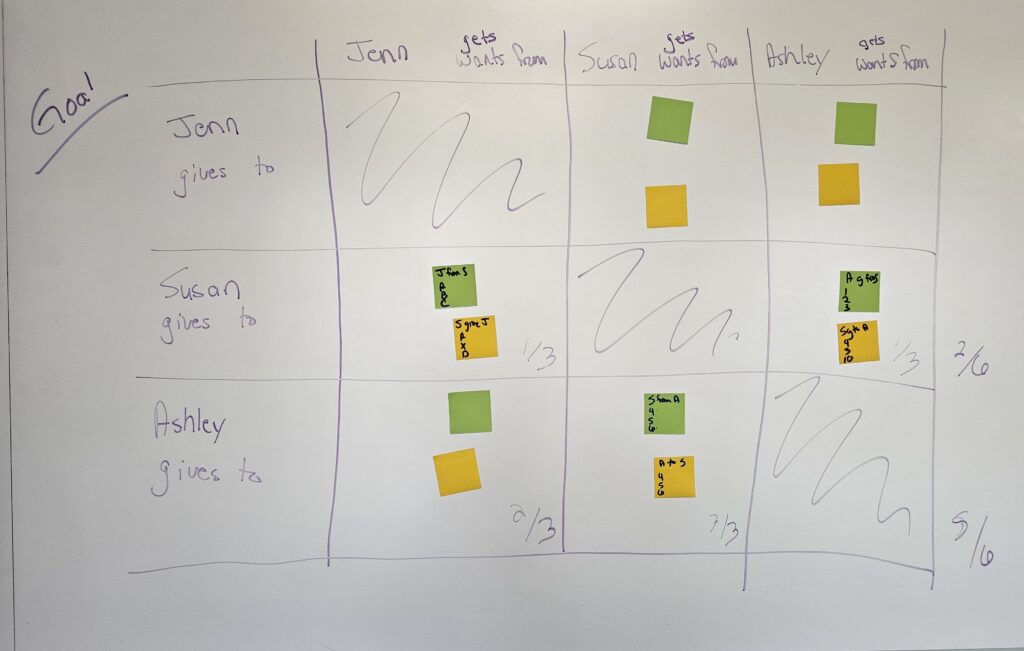
At the end of last year, I worked with the leaders at a small technology company. They have been going through tremendous change in response to the economy and new leadership. The new CEO is changing how they work by implementing cross-functional teams to tackle specific initiatives. They wanted to equip people leaders with practical strategies and tools to strengthen team cohesiveness and accelerate team performance. Ultimately, they wanted to reduce the time for teams to gel quickly and get results so they can move on to the next initiative.
In my October newsletter, I shared Tuckman’s model of group development. The HR leader read it and thought it could provide a framework for their leaders and support them in creating these agile teams. I facilitated a half-day session using Tuckman’s model as the foundation. We touched on psychological safety and introduced what I call “Give and Get”. It’s based on an activity by Thiagi, to clarify roles, expectations, and responsibilities. Team members identify a shared goal, then privately list what they want to get from each colleague and what they are willing to give in return. These are organized into a matrix, like the picture of the whiteboard, to reveal gaps and places where team members are misaligned. Then the team discusses and negotiates, which aligns expectations. The discussion improves the teams’ collaboration by increasing empathy for others and trust.
As so often happens, the workshop content became a springboard for deeper conversation. The real value emerged as these leaders stepped back from the day‑to‑day urgency, shared what the change felt like from their vantage points, and explored how to apply the ideas with their own teams.
Where might your team benefit from pausing, just as these leaders did, to explore how you’re working together, not just what you’re working on?
Conversation patterns of high-performing teams
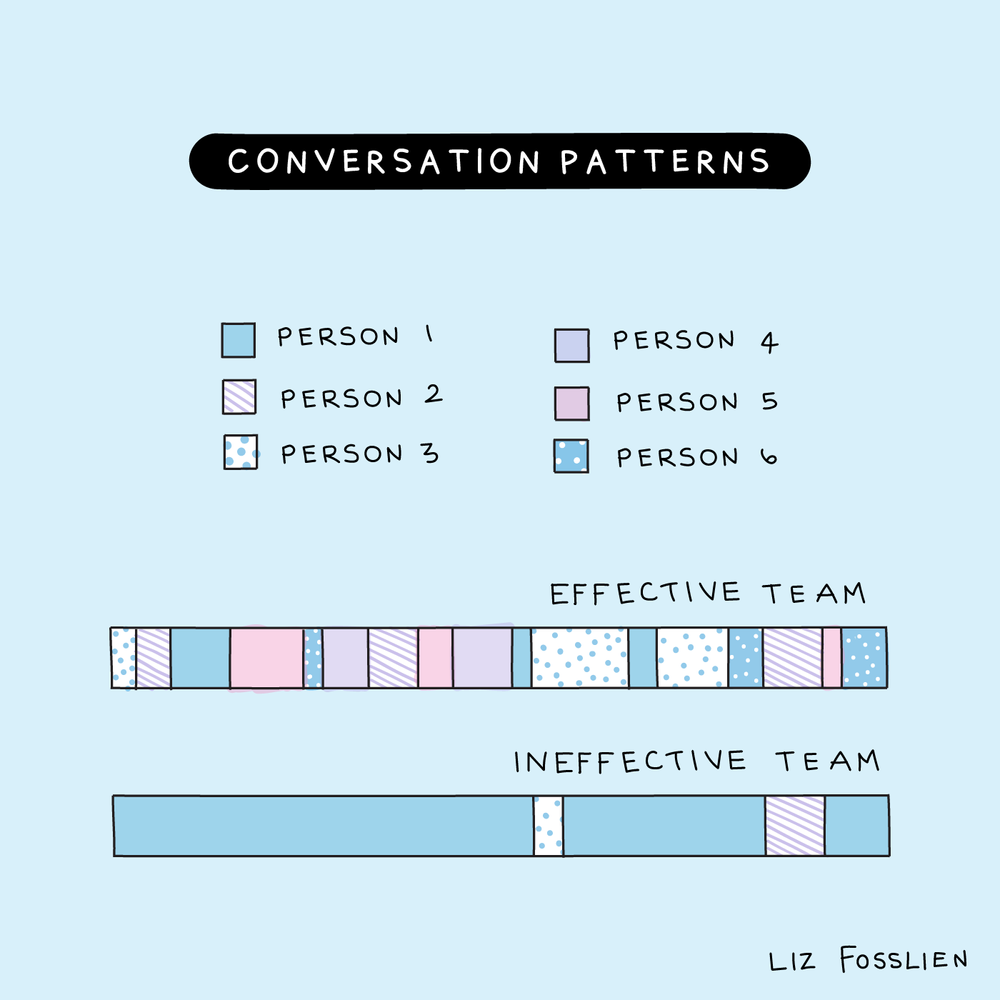
I love this illustration, Conversation patterns of high-performing teams, by Liz Fosslien. She has such a great way of distilling complex ideas into easy-to-understand visuals. Not sure I need to add much more – only to ask:
- What is the conversation pattern on your team?
- Where are the opportunities for you to talk less and listen more?
- How can you draw out the quieter folks on your team?
Illustration source: https://www.fosslien.com/liz-fosslien-effective-teamwork
In case you missed it
I’ve shared some additional posts online. Here they are, in case you missed them.
- Lead, Learn, Grow conversation card: New route to work (video link)
- Not Resolutions. Experiments. (video link)

